It started with a fourth medication.
Dana Kay’s son was five years old. He had been diagnosed with ADHD at four. The family had tried medication and watched it solve one problem and create three more. Appetite gone. Sleep wrecked. Anxiety climbing. And now a doctor was recommending a fourth prescription to manage the side effects from the first three.

Dana stopped. Not because she was anti-medication. She is clear about that. She stopped because something in her said: this cannot be the entire conversation.
So she started researching. Obsessively. Gut health, nutrition, inflammation. She dusted off her holistic science degree and earned multiple functional medicine certifications. And what she found changed everything.
Her son’s behaviors were not character flaws. They were signals.
His body was telling her something was wrong inside. When she started addressing what was happening biologically, rather than just managing the surface, things began to shift. The meltdowns got shorter. The emotional regulation improved. The hyperactivity calmed. Home got quieter.
Her son is sixteen now. He has been off medication for years.
Dana went on to found the ADHD Thrive Institute and has since supported more than 1,600 families through that same process.
I had her on the podcast because, well, first, she is awesome - but also because what she is learning and teaching needs to be heard more.
The gut-brain connection is real, and most families have never heard it explained
Ninety-five percent of serotonin and fifty percent of dopamine are produced in the gut. Not the brain.
The gut makes them. The brain uses them.
So when the gut is compromised, your child’s brain is literally running low on the neurotransmitters it needs to regulate emotions, sustain focus, and calm down.
And the frontal lobe, the part of the brain responsible for attention, planning, executive function, and problem-solving, communicates directly with the gut through the vagus nerve. When there is an overgrowth of bad bacteria in the gut, or chronic inflammation, those signals travel up and impair the brain’s ability to function. The kid who cannot sit still, cannot plan, cannot regulate. That is not just an ADHD brain. That may also be a gut that is sending the wrong signals.
Dana sees gut issues in the majority of children she works with. Many have been on multiple rounds of antibiotics, which wipe out beneficial bacteria along with the harmful kind. The gut ecosystem gets disrupted. The downstream effects show up as the behaviors we then label as ADHD symptoms.
This does not mean ADHD is not real. It means the picture is more complicated than we are usually told.
The no naked carb rule: where to start today
Before we got into the science, Dana gave us her quick win. It is simple enough to do at the next meal.
No naked carbs.
Any time you eat carbohydrates, pair them with protein or fat.
Apple with almond butter.
Crackers with turkey.
Toast with eggs.
Carbohydrates spike blood sugar on their own, and what goes up must come down. That crash affects attention, mood, and behavior for the whole family. Pairing carbs with protein or fat keeps blood sugar steadier, and steadier blood sugar means a steadier nervous system.
One rule. Every meal. Start there.
What functional testing actually looks like
Dana’s method centers on at-home functional lab testing. Stool analysis, urine testing, a small finger-prick panel. Everything ships to your house. No blood draws, no needles, no trying to get a dysregulated child to sit still in a clinic chair.
The results create a personalized plan: what to eat, what to avoid, which supplements this particular body actually needs. Because what works for one child will not work for another. Dana spent over $180,000 learning that through trial and error before the testing approach existed for her. The testing shortens that process dramatically.
She is also careful about food changes. When she first got her son’s results, he had forty food sensitivities. She removed everything on day one. She ended up on the floor of her bedroom in a panic attack wondering what she was going to feed him. That is not what she teaches now.
Rome was not built in a day. One change at a time. One week, one shift, until it becomes the new normal. Then the next one.
Choose your hard
One of the most honest things Dana said in our conversation was this: going to the grocery store and watching your child melt down in every aisle is hard. Changing what you put in the cart is also hard. But only one of those gets easier with time.
Choose your hard.
We are not asking for perfection. We are asking for a first step. A different design for what goes on the plate. A body that gets a better chance to regulate.
Dana’s son eats gluten now, by the way. Occasionally. Because his overall inflammatory load is low. She uses the trash-can metaphor: when the can is mostly empty, a little trash does ’t overflow it. The goal is not a pristine diet forever. The goal is a calmer, lower-inflammation baseline that gives the brain room to work.
This is not an either/or conversation
This is not anti-medication. There is a time and a place for medication. What Dana argues, and what the research on ADHD as a diagnosis of exclusion actually supports, is that we should be ruling out biological drivers first. Testing first. Addressing gut health, nutrition, and inflammation first. And if medication is still needed after that, the body is in a better place to receive it.
More than 1,600 families have been through her program. Every single one has seen improvement. Thriving looks different for each of them. But the common thread is a home that is calmer, a child who feels better about themselves, and parents who finally feel like they have more than one tool.
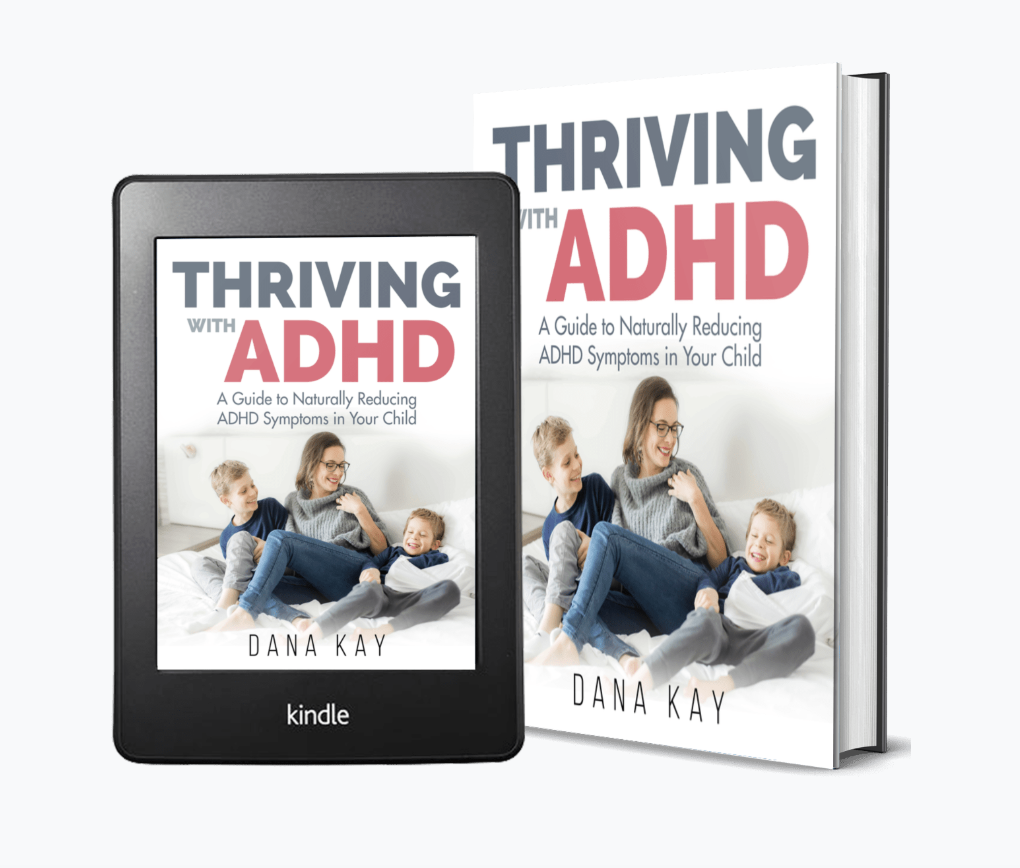
Find Dana at adhdthriveinstitute.com. She offers free online training and a free call with her team to build a roadmap for your child. Her book, Thriving with ADHD, is an international bestseller and a practical place to start.
And if you want one thing to take away from this episode: no naked carbs. Pair everything. See what happens.
If you don’t want to miss out on conversations like these, be sure to sign up for the ADHD mom newsletter to keep in touch!
Listen to my conversation with Dana Kay - podcast episode below - be sure to subscribe to the show!
